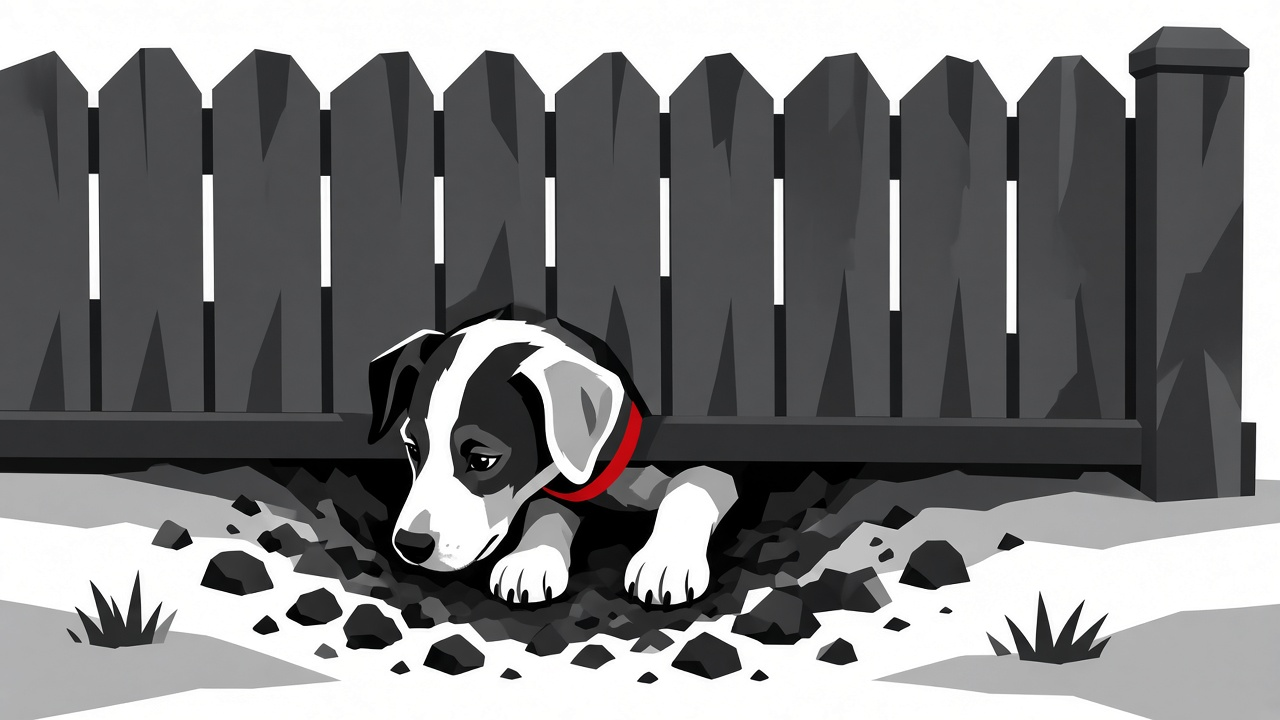
Every dog owner knows the feeling. You open the back door, and the yard is empty. Somewhere there's a hole under the fence, a loose board, or a gate that didn't latch. Now you're driving the neighborhood calling their name.
The right fence fixes that. Not just any fence, though. A dog proof fence has to match the dog: how big it is, whether it digs, whether it jumps, and whether it treats your fence like a chew toy.
I'm Manuel, and I've been doing carpentry for over 10 years. Here's how I dog proof a fence so your dog stays in your yard: a tight bottom, a dig guard or buried mesh, a self-closing latch, and the good side facing in if your dog needs it.
Start with your dog: digger, jumper or chewer?
Before we talk about wood or steel, think about how your dog would get out if it could. Most escape artists fall into one of three groups.
- Diggers go under. Some dogs dig out of boredom, some to chase a smell, and some just because they can.
- Jumpers and climbers go over. Athletic, high-energy dogs can clear a short fence, and some climb a fence that gives them a foothold.
- Chewers go through. A dog that chews on wood can work at a board or a gap until it gets loose.
A lot of dogs are a little of all three. Tell us what yours does, and we'll build for it.
How tall should a fence be for my dog?
Height comes down to your dog's size and how athletic it is.
- Small dogs: in my experience, small dogs that don't jump much are often fine behind a 4-foot fence, as long as there are no gaps they can squeeze through.
- Medium and large dogs: in my experience, they do better behind a 5- or 6-foot fence, and that's what I usually recommend.
- Big jumpers and climbers need all the height you're allowed to build, with a smooth face that gives them less to push off from.
Before you pick a height, check the city's limits and your HOA. In Colorado Springs, front-yard fences can't go over 4 feet, and any fence over 7 feet needs a building permit from Pikes Peak Regional Building Department. Many HOAs set their own lower caps. Banning Lewis Ranch, for example, limits most fences to 4 feet. So check your HOA first. These are City of Colorado Springs rules; if you're outside city limits, your town or El Paso County sets its own. Read our post on HOA fence rules in Colorado Springs before you commit to a height.
Dog proofing the bottom: stopping diggers
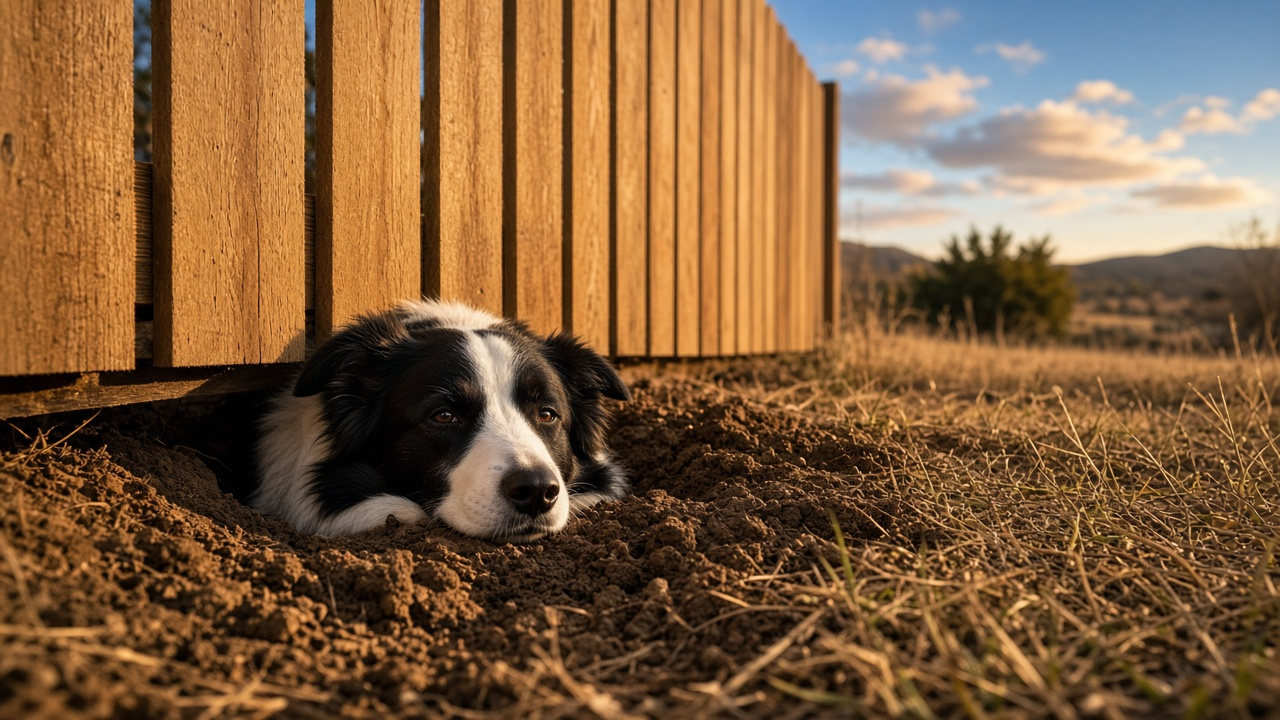
In my experience, digging under the fence is how most dogs get out. A dog that digs doesn't care how tall your fence is. It cares about what's at the ground.
- Keep the bottom tight. We set the bottom of the fence close to the ground, so a digger has no easy gap to start a tunnel.
- Add wire mesh. On cedar split rail, I've added wire mesh to keep dogs in.
- Add a dig guard or buried mesh. On cedar privacy and chain link, we can add a dig guard along the bottom of the fence or bury wire mesh below it. Either one gives a digger something that's much harder to tunnel through, and we'll help you pick the right one for your yard and your dog.
- Watch the low spots. Colorado Springs yards slope, and every dip under a fence gives a digger a head start. We follow the grade, so the gaps stay small.
Dog proofing checklist: what we can add to your fence
Dog proofing isn't one product. It's a few small details that work together, and we build in the ones your dog needs.
- Dig guard or buried mesh along the bottom. In my experience, digging under the fence is the most common way dogs get out, so this is where I start. Either one helps, and we'll help you pick.
- A self-closing, self-latching gate. A gate left open can still let a dog slip out, so we install self-closing gate latches on request.
- Good side in. If your dog climbs or pushes on the fence, we can build it with the good side facing in when you ask. Check your HOA first.
- A tight bottom that follows the grade, so a digger has no easy gap to start.
Tell us what your dog does, and we'll build the fence to match.
Stopping jumpers and climbers
For a jumper, height is the first answer. The second is taking away anything to push off from.
- A solid cedar privacy fence gives a dog nothing to see through, and with the smooth side facing your dog, little to climb.
- Keep dog houses, woodpiles, trash cans and patio furniture away from the fence line. They work like a step stool.
- Normally the smooth side faces out and the rails face your yard. If your dog is a climber, we can build good side in when you ask, but check your HOA first. Some HOAs require the finished side to face out, especially along streets and common areas.
Stopping chewers and squeezers
Chewers and small dogs that squeeze through gaps need a fence with no weak spots.
- Tight boards. Board-on-board cedar privacy overlaps the boards, so the gaps stay covered as the wood dries.
- Chain link is another good option for chewers. We install both galvanized and vinyl-coated chain link (more on that below).
- Repair the weak spots fast. One loose board or bent section is all it takes. I repair all fence types, so call before a small gap turns into a big one.
Gaps, gates and latches
In my experience, digging is the big one, but a gate left open or a gap beside it can still let a dog slip out.
- Gaps under and beside the gate. We keep the gap under the gate small and the space at the hinge and latch side tight.
- Gates that sag. A sagging gate drags, won't latch, and gets left open. A gate needs stout posts. On split rail, we hang gates on an added 6x6 cedar post.
- Latches. A self-closing gate with a latch that catches on its own helps when kids or guests forget. We install self-closing, self-latching gate hardware if you want it. Put the latch where your dog can't nose it open.
The right fence type for your dog
Here's how each fence we build stacks up for a dog.
Cedar privacy fence
My go-to pick for most dogs in town. It's tall and solid, and your dog can't see through it, so there's less going by to bark at. We set every post at least 30 inches deep in concrete. That's my own standard on every fence we build, except split rail, where posts go in gravel and dirt. See the styles on our cedar privacy fence page.
Steel post fence
It's the same cedar fence, built on Postmaster galvanized steel posts. Steel posts give the fence a strong backbone, which matters when a big dog leans, jumps or pushes on it. Posts go at least 30 inches deep in concrete. Learn more about our steel post fence.
Cedar split rail with wire mesh
Split rail looks great on acreage in Black Forest, Falcon, Peyton and Monument, but on its own the rails are wide open for a dog. That's why I've added wire mesh to 2-rail and 3-rail split rail to keep dogs in. Split rail posts are set in gravel and dirt, not concrete. See our cedar split rail fence.
Buckley steel fence
We install Buckley in 3-rail and 4-rail. It's built for horses and acreage, and it makes a strong, good-looking perimeter. The top rail sits at 54 inches, and the open rails won't hold most dogs by themselves. Buckley makes wire mesh clips for attaching mesh to keep smaller animals like dogs inside. If you've got horses and dogs, ask us about a dog-friendly yard area inside the bigger fence. Learn more about the Buckley steel fence.
Chain link
Galvanized or vinyl-coated chain link is a practical choice for dog runs and big yards, and it holds up to a chewer much better than wood. The trade-off is that your dog can see everything going on, and some dogs can climb it. For bigger chain link projects, see our post on commercial chain link fencing in Colorado Springs.
Dog proofing a fence you already have
Already have a fence and a dog that keeps finding a way out? We can often dog proof it. I repair all fence types: loose boards, leaning posts, sagging gates and gaps at the bottom. Sometimes a repair does it. If the fence is old, too short for your dog, or full of weak spots, replacing it is often the better deal, and you get a fence built around your dog from day one. I'll take a look and tell you what I'd do if it were my dog.
I build fences all over Colorado Springs, including Broadmoor and Old Colorado City, plus Fountain, Security-Widefield, Monument, Peyton, Falcon, Black Forest, Woodland Park, Manitou Springs, Green Mountain Falls and Cripple Creek.
Dog fence FAQs
What is the best fence for dogs in Colorado Springs?
For most dogs in town, a cedar privacy fence is my go-to pick. It's tall and solid, so your dog can't see through it, and with the smooth side facing your dog there's little to climb. If you have acreage, cedar split rail with wire mesh added can keep dogs in while keeping that open ranch look.
How tall should a fence be for a dog?
In my experience, small dogs are often fine behind a 4-foot fence with no gaps. For medium and large dogs, I usually recommend a 5- or 6-foot fence. In Colorado Springs, front-yard fences max out at 4 feet, and anything over 7 feet needs a building permit. Check your HOA first.
How do I dog proof a fence?
Start at the bottom, since in my experience digging under the fence is the most common way dogs get out: a tight bottom that follows the grade, plus a dig guard or buried wire mesh. Add a self-closing, self-latching gate, and ask for the good side facing in if your dog climbs. Check your HOA first. Tell me what your dog does and I'll build for it.
How do I stop my dog from digging under the fence?
Keep the bottom of the fence tight to the ground and follow the grade so there are no low spots. On cedar privacy and chain link, we can add a dig guard along the bottom or bury wire mesh below it. On cedar split rail, I've added wire mesh to keep dogs in.
Can a split rail fence keep a dog in?
Not by itself, because the rails are wide open. With wire mesh added to a 2-rail or 3-rail cedar split rail fence, it can keep a lot of dogs in. Gates hang on an added 6x6 cedar post.
Do you repair fences that dogs have damaged?
Yes. I repair all fence types, including loose boards, leaning posts, sagging gates and gaps at the bottom. If the fence is old or too short for your dog, replacing it is often the better deal, and I'll tell you what I'd do.
Get a free estimate
Ready for a fence built for your dog? Call (719) 330-7146, Monday through Saturday, 8 to 5, or get a free estimate. Tell me about your dog, and I'll show you exactly how I'd build it for your yard.