The short answer: In Colorado Springs, stain your fence from May onward in spring, after the average last freeze around May 8. In fall, aim for September to early October, and finish before the average first freeze around October 2. Pick dry days within your stain label's temperature range, often about 40 to 50°F at the low end and up to 90°F at the top, and leave 24 to 48 hours of dry weather afterward.
We stain fences all over town, and timing is a question we hear a lot. Here's my take, using National Weather Service (NWS) Pueblo climate data and the stain labels themselves.
What's the best time of year to stain a fence in Colorado Springs?
Late spring and early fall are the sweet spots, and summer works too. The catch is that each window opens and closes earlier than most people think. NWS Pueblo's 1991 to 2020 normals put Colorado Springs lows at 34.0°F in April, 43.5°F in May, 48.9°F in September and 36.6°F in October. Many labels set a minimum of around 40 to 50°F, and some warn against temperatures below 40°F in the 48 hours after you apply. So April and late October are risky, while May through September usually leave room to work.
Summer isn't off the table
Summer highs run in the 80s (86.5°F in July), and many labels top out around 90°F. Summer staining is fine in the early morning or on shaded sections, away from midday sun and heat.
Fall vs. spring: when do the windows open and close?
Fall: September to early October
A lot of folks plan to stain "in the fall, before the snow." In Colorado Springs, the freeze comes first. According to NWS Pueblo:
The average first freeze is October 2.
The chance of hitting 32°F is 50% by October 3 and 90% by October 15.
The October normal low is 36.6°F, below the 40°F overnight floor on several labels.
The average first measurable snow isn't until October 25 (per the newer NWS snow page; an older NWS page lists October 19).
So the useful fall window runs from September into early October. Some years give you longer (the 2025 first freeze came October 19), but we don't plan around a lucky year.
Spring: May onward
Spring opens later than the calendar says. The average last freeze is May 8, and the average last measurable snow is April 23. For products with a 40 to 50°F minimum, April is a gamble. From May on, with normal highs around 70.7°F, conditions line up much better.
Temperature, humidity and rain: the rules on the can
Every stain is different, so the label on your can is the final word. Here are a few examples:
Behr Premium Semi-Transparent: apply at 40 to 90°F on completely dry wood, with no rain expected for 24 hours. Full cure takes 72 hours.
Sikkens/PPG ProLuxe Cetol SRD (technical data sheet): air and surface temperature 50 to 90°F. Relative humidity ideally 15 to 55% and no more than 85%. The surface should be at least 5°F above the dew point. Don't apply in direct sun, or if rain, snow, heavy dew or temperatures below 40°F are expected within 48 hours.
Ready Seal (oil): the maker says there are no temperature restrictions and it can go on in direct sun, but the wood must be at or below 12% moisture. It says rain within hours is OK if the prep is right. Full cure takes up to 14 days.
How long after rain or washing should you wait?
The wood has to be dry through, not just on top. The Canadian Sikkens data sheet calls for moisture below 18% and 48 hours of drying after cleaning; Ready Seal wants 12% or less. Plan on about 48 hours after a soaking rain or power wash, or use a moisture meter.
How long does stain need before it rains?
Most labels we checked ask for 24 to 48 hours of dry weather after you apply. Our climate is dry (about 15.91 inches of precipitation a year, per NWS Pueblo), but afternoon storms sneak up, so check the forecast.
How long should a new fence sit before its first stain?
There's no single answer, because manufacturers disagree on new cedar:
TWP (1500 Series label): give new wood 4 to 12 months of natural weathering, then clean it and let it dry at least 48 hours.
Ready Seal: new cedar needs about 2 to 4 weeks to dry, and the wood must be at or below 12% moisture.
Sikkens/PPG Cetol SRD: do a water splash test. If the wood doesn't absorb the water, wait 30 days and test again.
For new pressure-treated wood, Ready Seal says at least a month (2 to 3 months recommended), and the Canadian Sikkens sheet says 6 weeks.
My advice: follow the label on the stain you're using, do a splash test or check the boards with a moisture meter, and stain a test board first. If your fence goes in late in the season, the first coat may have to wait until May.
Stain types: transparent, semi-transparent and solid
Transparent and semi-transparent stains let the grain show, which is why they're popular on cedar, and they don't form a film, so they don't peel. The tradeoff, per the USDA Forest Products Laboratory (FPL) and Consumer Reports, is a shorter life. Solid stains last longer but hide the grain, and Consumer Reports notes they can build up a film that peels.
Oil-based vs. water-based
According to the FPL, oil-based semi-transparent stains soak into the wood and work better brushed on, while waterborne "semi-transparents" form a thin surface film. Either way, follow the label.
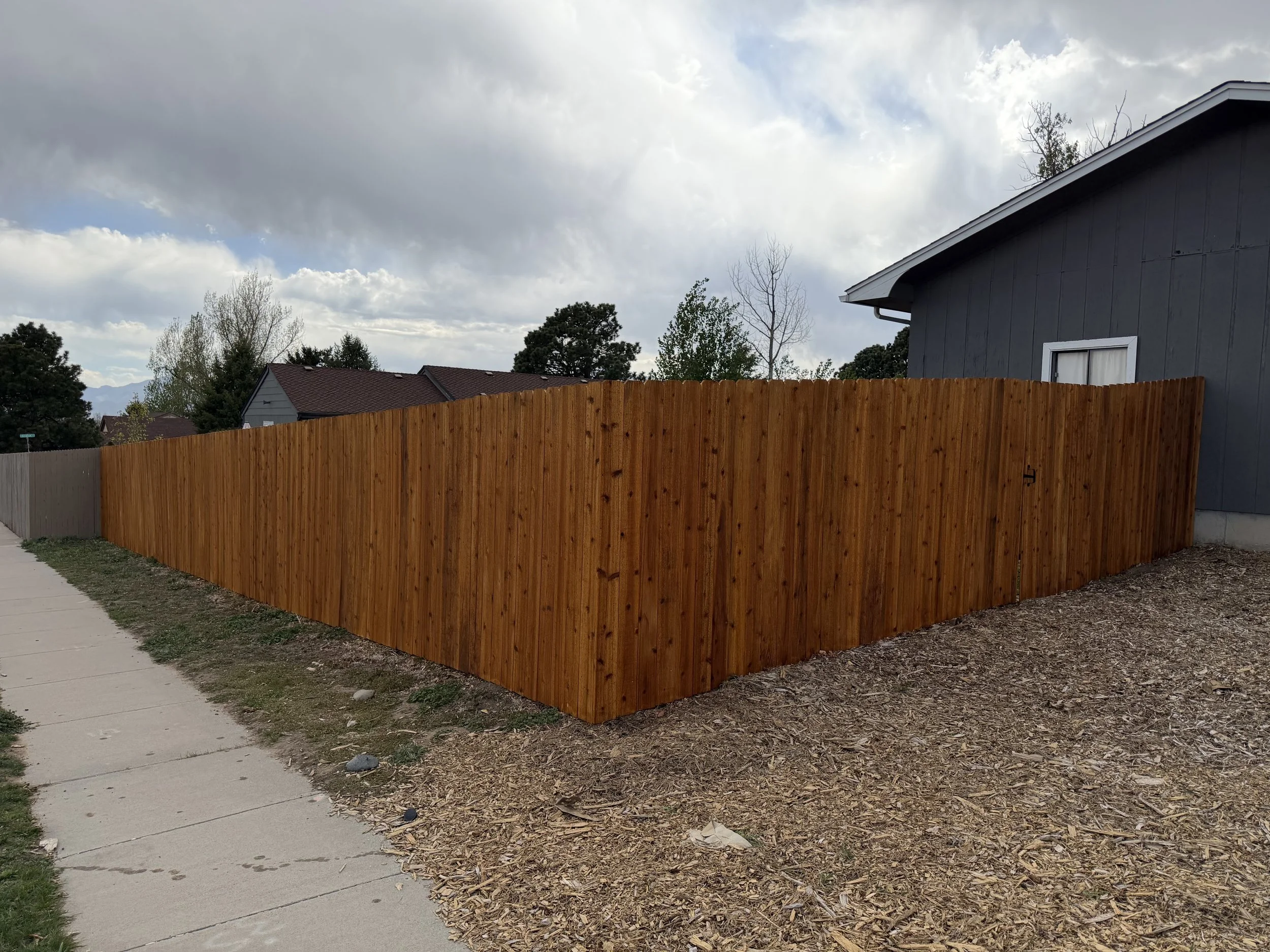
Hoping to match this look? A photo is only a rough guide. Camera settings, sun angle, the wood batch, drying time and number of coats all change the color, and cedar varies board to board. Ready Seal notes its stain looks darker at first and reaches its true color over a week or two. Test on a board of the same wood and judge it in daylight once fully dry.
What does stain actually do for a fence?
Stain protects the surface. The FPL names UV as the main driver of weathering, and a finish helps hold color and resist checking and mildew. Unstained wood weathers on its own and loses its fresh color. Our high-altitude sun is intense, and in our experience south- and west-facing runs fade first. Stain won't stop rot, though: rot comes from moisture and ground contact, and the FPL says in-ground posts need pressure-treated or naturally durable wood.
How often should you restain your fence?
It depends on the wood, the stain and how much sun the fence gets:
The FPL Wood Handbook says semi-transparent stain on cedar lasts about 2 to 4 years on smooth boards and 4 to 8 years on rough-sawn boards. Those figures are for siding, and the FPL notes that fences are more exposed and may need refinishing sooner.
TWP says color fades first, often within 12 to 24 months, and uses that fading as the cue to recoat.
Consumer Reports found that on decks, the top-rated solid stains last 3 to 5 years and semi-transparents about 2 to 3 years. Fences are vertical, so they wear less than decks.
Watch your fence. When the color fades, especially on the sunny sides, plan the next coat for May or September, and give us a call to get on the schedule.
Cheap vs. premium stain: what does the extra money get you?
In the retailer listings we checked, prices varied a lot from brand to brand, and so did Consumer Reports' rated stains. Coverage runs roughly 100 to 400 square feet per gallon for a first coat, depending on the product and how rough the wood is.
The extra money usually buys more pigment and solids, and the FPL says pigment increases service life, meaning longer UV protection and color. But Consumer Reports has noted that price doesn't always predict performance. Pick a product whose label fits your wood and timing. Prep and weather matter as much as what's in the can.
How Paragon handles fence staining
We stain fences for our customers, and we'll do both sides when you want the neighbor's side done too. On repairs, we color-match new boards so the fix blends in. We schedule around the windows above, check the wood first, and follow the label on whatever product we use.
FAQ
Can you stain a fence in the fall in Colorado Springs? Yes. Aim for September to early October. The average first freeze (October 2) arrives before the average first snow (October 25).
Is April too early? Usually, for stains with a 40 to 50°F minimum. April's normal low is 34°F, and the average last freeze is May 8.
What time of day is best? Skip midday sun and heat. Mornings or shaded sections work better. The Sikkens data sheet also says to avoid late in the day, when dew forms.
Get a free fence staining estimate
If you'd like your fence stained in the next good window, or you just want to know if it's ready for a fresh coat, give us a call at 719-330-7146 or get a free estimate. Estimates are always free, and we're happy to talk through timing and stain options.
Sources
NWS Pueblo, Colorado Springs daily normals and records (1991–2020)
NWS Pueblo, average first and last measurable snow (older page)
Ready Seal FAQ ; application instructions ; TDS ; brochure
USDA Forest Products Laboratory, Wood Handbook (GTR-190), Chapter 16, Finishing of Wood
Natural, accelerated and simulated weathering of wood: a review (BioResources)